
Voluntary Hardship: Why Your Fitness Needs the Mud
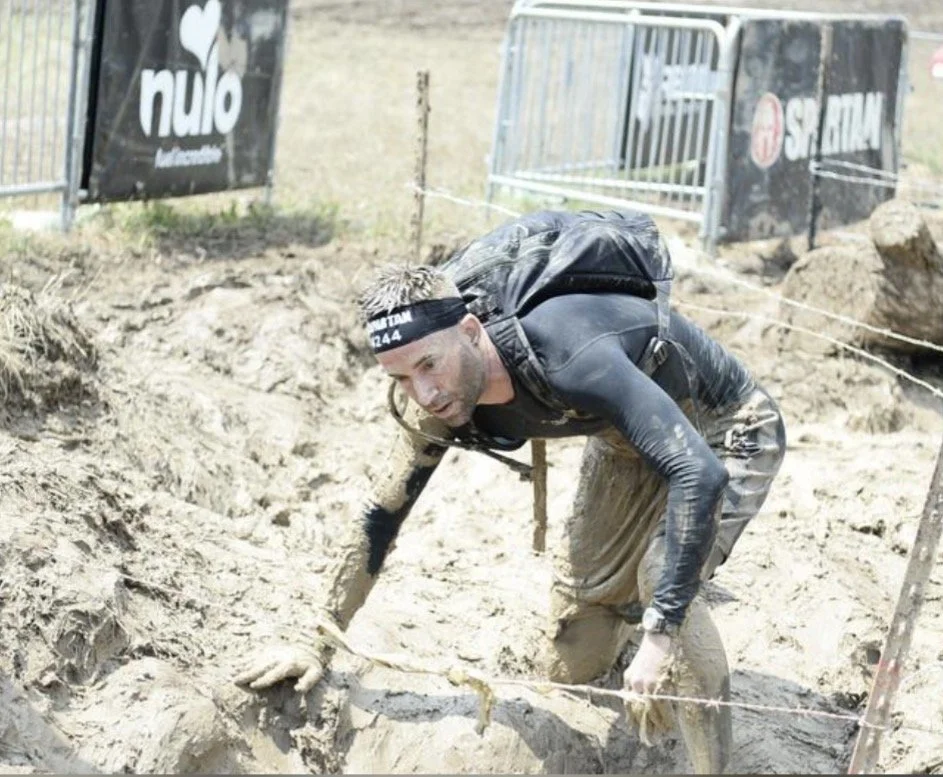
Brett Thomas navigating a rugged mud obstacle during a Spartan Super, demonstrating real-world physical capability and functional fitness training.
In my previous blog, I asked a question that makes a lot of people uncomfortable: physically speaking, are you an asset or a liability?
We talked about stewardship, our hunter-gatherer roots, and the moral obligation to keep our bodies useful to our families, our communities, and the Creator who designed them. That is a necessary framework, but it is very easy to read those words, nod along in agreement, and still leave your capability entirely in the realm of theory. It is easy to look at a perfectly calculated workout log in a climate-controlled gym and feel prepared.
A controlled environment can build strength, but it cannot fully prove capability.
If you want to know what you are actually made of when life demands action, you have to leave the rubber mats and the air conditioning behind once in a while. For me, that means training for and running obstacle course races and rucking events. As long as my body is physically able to move, this is where I will be. Not because I am chasing medals, but because real life does not always happen in perfect conditions, and the trail is where theory meets reality.
The Architecture of Chaos
Real life is usually uneven, awkward, heavy, cold, wet, and inconvenient. It does not care about your personal records on a perfectly balanced barbell, and it definitely does not care whether your shoes are clean.
When you step onto an obstacle course, you are volunteering for an environment that actively tries to break your rhythm and disrupt your comfort. You are not lifting molded iron with a knurled grip. You are hoisting shifting sandbags, dragging raw logs, carrying buckets of gravel, and wrestling atlas stones. You are not on a motorized treadmill with a shock-absorbing deck. You are navigating thick mud, loose shale, steep inclines, and unpredictable trails.
You also do not get to dial in a thermostat. When I run events in Wisconsin during the dead of November or the freezing depths of January, the weather is not background scenery. It becomes part of the test. Cold fingers, slick ground, wet clothes, and frozen lungs have a way of exposing whether your mind is ready to keep working when your body wants a meeting with management.
To navigate this kind of terrain well, your body has to communicate with the ground. That is one reason I train almost entirely barefoot in my backyard, my neighborhood, and state parks, and why I race in minimalist Vibram V-Trail shoes. When your footwear completely isolates you from the ground all the time, you can lose some of that natural feedback, foot strength, and adaptability. The individual toe pockets allow my feet to naturally articulate, grip, and feel the terrain, while still providing enough protection for rocks, roots, mud, and cold ground. True capability starts from the ground up.
The Lineage of Functional Suffering
We did not invent this style of training. Modern gym culture, with its mirrors, machines, and isolated muscle movements, is a very recent chapter in human history. For most of our story, physical preparation was tied directly to survival, work, service, and protecting the people around you.
In ancient Persia, training systems like Varzesh-e Bastani, or Heroic Sport, used heavy wooden clubs, shields, and bodyweight movements to build strength, coordination, endurance, and toughness. In ancient Greece, events like the pentathlon tested running, jumping, throwing, and wrestling, qualities that had obvious overlap with the demands of battle, sport, and civic life.
Roman military capability depended on men who could march long distances under heavy loads, move through rough terrain, build, dig, fight, and keep going when conditions were miserable. In Scotland, heavy stones, logs, and implements became part of a long tradition of testing strength and durability through the Highland Games. Different cultures had different methods, but the pattern is obvious. Capability was trained with real objects, real terrain, and real consequences.
When you carry a load across rough earth, you are not participating in some random modern fitness trend. You are tapping into a hard-won biology that stretches back long before mirrors, machines, and macro calculators.
Finding the Breaking Point
If the goal is usefulness, you cannot only train where everything is safe, predictable, and padded. You have to occasionally choose experiences that expose weak links, because that is where you learn how your body and mind actually perform under stress.
For me, that has meant testing my limits against Midwest terrain at the Highlander Assault, embracing the freezing elements of the Abominable Trail Race, and moving beyond standard short-course events to take on longer efforts like the Spartan Ultra.
During the Ultra, I spent nine hard hours on the course, moving directly through heavy thunderstorms and the brutal aftermath they left behind. When the skies open up like that, the venue changes instantly. Trails turn into rivers of thick, energy-sapping mud, obstacles become slick and hazardous, and staying warm becomes a real concern. Spending that much time exposed to the elements forces you to answer a hard question: what do you do when the environment strips away your comfort and you still have miles left to cover?
You adapt. You manage your fuel. You keep moving.
That same pursuit of heavy endurance is what led me to GORUCK events. After completing both the Basic and the Tough, I learned what it feels like to put 30 pounds of steel on your back and move through the dark for hours with a team. Events like that strip away a lot of ego. When you are tired, wet, sore, and uncomfortable, the question eventually shifts from, can I finish, to, can I still be useful to the person next to me?
That is where the asset gets forged.
Your Proving Ground Does Not Have to Be Mine
I am not asking everyone to run a Spartan Ultra, sign up for a GORUCK Tough, or crawl through frozen mud in January. That would be ridiculous, and honestly, a pretty terrible first step for most people.
Your proving ground could be a loaded hike, a winter walk, a long day in the woods, a hard ruck, a backyard sandbag session, a camping trip where comfort is not guaranteed, or even a local trail race that scares you just enough to make you prepare. The point is to put your body in contact with reality often enough that you know what it can do.
A gym can absolutely be part of that process. I lift. I use kettlebells, steel maces, sandbags, and all kinds of training tools. Strength matters. But strength becomes more useful when you take it outside, carry something awkward, move across uneven ground, feel the weather, and learn how your body behaves when the conditions are less than ideal.
You do not need to live like a survivalist or turn every weekend into a sufferfest. You just need enough honest testing to know whether your training is building the kind of capacity you can actually use.
The Risk of Safety
Every time I sign a race waiver, I acknowledge that something could go wrong. I have seen injuries on the course, broken arms, bad knees, torn hands, separated shoulders, and plenty of people who found out the hard way that obstacles do not care how confident you felt at the starting line.
That is a calculated risk, and everyone has to decide what level of risk makes sense for them. But I will take the risk of occasional discomfort, bruises, scrapes, and the possibility of injury over the certainty of letting comfort quietly steal my physical usefulness.
Obstacle races and rucking have taught me things that are hard to learn in perfect conditions. How to fuel when I am depleted. How to hydrate under stress. How to keep moving when the weather turns. How to manage fear, frustration, cold, mud, fatigue, and that little voice that starts making a surprisingly polished argument for quitting.
Modern life sells comfort, removes effort, and makes dependence feel normal. I do not think that is a great trade. Build your body in the gym, yes, but also build it in the backyard, on the trails, at the campsites, in the snow, in the rain, and on the days when conditions are less than perfect.
Stop training only for the mirror. Find a proving ground. Put your body in contact with reality. Build the kind of fitness that can actually be used.
See you out in the mud.
