
The Hidden Toxic Load: Ancestral Swaps for Food, Clothes, and Cookware
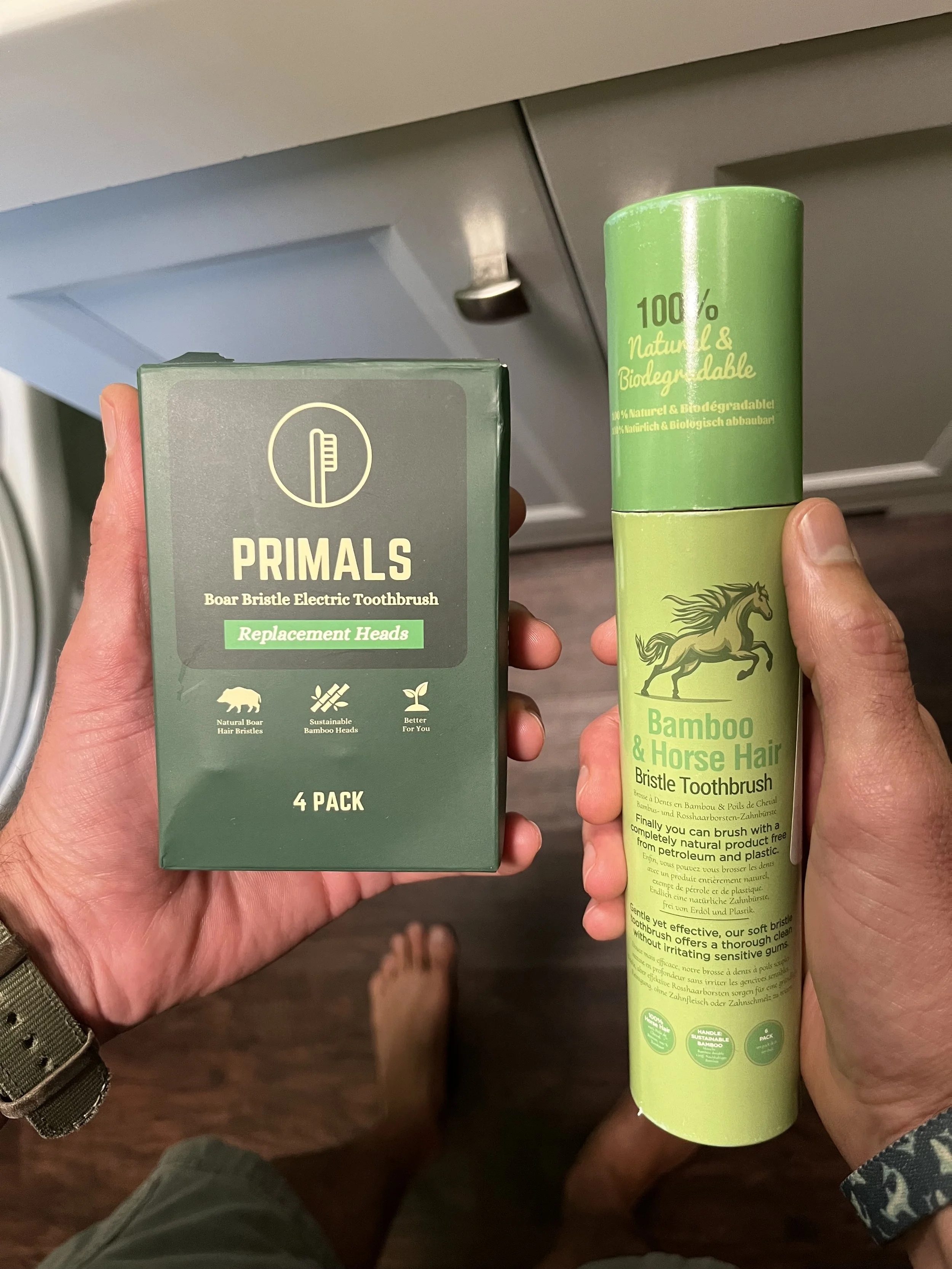
Simple ancestral dental swaps: wooden handle, boar/horsehair bristles, and plastic-free floss.
When people ask me what it means to live ancestrally, they often picture sprinting barefoot through the woods or lifting heavy objects outdoors. While physical movement is a massive piece of the puzzle, true ancestral health is just as much about what you keep out of your body.
Our ancestors lived in direct contact with the natural world. Their bodies adapted over millions of years to handle dirt, sunshine, seasonal shifts, and wild foods. What their biology was never designed to process is the relentless, daily chemical exposure of the modern world.
Today, we are swimming in a sea of synthetic materials. Two of the biggest hidden stressors on our biology are chemical leaching (xenoestrogens, BPA, and its chemical replacements) and microplastic shedding, tiny synthetic particles that are now being found throughout the human body.
If your goal is long-term health span, vitality, and hormonal balance, reducing unnecessary exposure makes sense to me. I take a better-safe-than-sorry approach here. We may not yet know the long-term human consequences of every low-level exposure, but if something can be easily reduced without making life considerably harder, I would rather reduce it than wait decades for perfect data. You don't need to live in a cave to do this; you just need to make deliberate, high-impact swaps.
The Invisible Cocktail: What Leaches Into Your Biology
It isn't just about "plastic" as a single material, it's about the synthetic additives, industrial compounds, and persistent particles that migrate into our bodies when materials meet heat, friction, or high temperatures. Here is what modern research reveals about these hidden stressors:
PTFE and PFAS ("Forever Chemicals"): Non-stick Teflon pans rely on fluoropolymer coatings. Under normal use, regulatory agencies consider migration from these coatings to be negligible, but negligible is not the same as zero. When pans are overheated or the coating becomes damaged, degradation and shedding become a greater concern. My approach is simple: if I can eliminate an unnecessary exposure by using cookware that performs just as well, I would rather do that.
Bisphenol Substitutes (BPS, BPF): When products claim to be "BPA-Free," manufacturers often replace BPA with chemical cousins like Bisphenol S or Bisphenol F. These compounds can also interact with hormone signaling and have raised many of the same endocrine concerns that led people to move away from BPA in the first place.
Phthalates (Plasticizers): Used to make plastics soft and flexible, phthalates are not chemically bound to the material. Heat, fats, and acids can cause them to leach more readily, and research has raised concerns about their effects on hormones and metabolic health.
Microplastics and Nanoplastics (MNPs): Tiny physical particles shed from synthetic clothes, nylon bristles, plastic packaging, and countless other sources. Microplastics and nanoplastics have now been found throughout the human body, while animal and laboratory studies continue to raise legitimate questions about inflammation, hormone disruption, reproductive health, and other biological effects. We still do not know the full long-term impact in humans, but for me, the evidence is concerning enough that when an exposure is easy to avoid, I would rather reduce it than assume it is harmless.
1. Ditch Non-Stick Pans for Stainless Steel and Cast Iron
Non-stick cookware is one of the most widespread sources of synthetic coatings in the modern kitchen. Most non-stick pans are coated with PTFE, a fluoropolymer in the PFAS family. While exposure during normal use may be considered very low, these coatings can degrade when subjected to excessive heat or become damaged with use. For me, if there is an equally functional option that eliminates the coating altogether, that is an easy swap. "Ceramic" non-stick pans are often marketed as a clean alternative, but their coatings can also degrade under daily use, requiring more frequent replacement.
Living ancestrally means returning to traditional, indestructible, non-toxic metals:
Cast Iron: The ultimate ancestral kitchen workhorse. A well-seasoned cast iron skillet relies on polymerized fats, not synthetic chemicals, to create a natural non-stick surface. It handles high heat effortlessly, lasts for generations, and leaches trace amounts of dietary iron into your food.
Stainless Steel: High-grade stainless steel (like 18/10 or tri-ply) is non-reactive, extremely durable, and completely free of PFAS and synthetic coatings. It is ideal for cooking acidic foods (like tomato-based dishes, citrus, or wine reductions) that might strip the seasoning on a cast-iron pan.
2. Kitchen Storage: Stop Heating Your Food in Plastic
Heat and plastic are a disastrous combination. When plastic gets warm, the chemical bonds loosen, drastically accelerating the leaching of xenoestrogens and phthalates into your meal.
Ditch the Tupperware for Glass: Swap synthetic storage containers for Pyrex or tempered glass. Glass is completely inert, meaning it will never leach chemicals into your food, no matter how hot or acidic it gets.
Never Heat Food in Plastic: If you need to warm up leftovers, transfer them to a glass bowl or a cast-iron skillet first. Microwaving or heating food in plastic containers, or covering hot food with plastic wrap, creates a direct pathway for chemical migration.
3. The Beverage Trap: Coffee Cups, Cans, and Water Bottles
Hydration should support your health, not add to your chemical load. Unfortunately, modern beverage packaging is packed with hidden plastics and coatings.
The Takeout Coffee Cup Illusion: That paper cup from your favorite coffee shop isn't just paper, if it were, the liquid would dissolve it in minutes. It is lined with a thin layer of plastic. When scalding hot coffee hits that lining, it creates another opportunity for plastic particles and chemicals to migrate into your drink. Bring your own stainless steel or glass travel mug.
Ditch the Single-Use Plastic Bottles: Drink exclusively out of high-grade stainless steel or glass. Single-use plastic bottles can release microplastics and other compounds, especially if they’ve been sitting in a warm car or exposed to sunlight.
Watch Out for Aluminum Cans: Even if you avoid soda, keep in mind that aluminum cans (for sparkling water or tea) are lined with a polymer coating on the inside to prevent the liquid from corroding the metal. If reducing contact with synthetic materials is your goal, this is another exposure worth being aware of.
4. Clothing: Wear Real Fibers, Not Synthetic Petroleum
Most modern clothing is essentially wearable plastic. Polyester, nylon, acrylic, and spandex are petroleum-based synthetics. Every time you wear them, sweat in them, or wash them, they can shed microscopic plastic fibers into your home, laundry water, household dust, and surrounding environment. Research is still developing around exactly how much of this material can enter the body directly through intact skin, but synthetic textiles are clearly another significant source of microplastic pollution. For me, if I am going to have fabric against my skin for eight or twelve hours a day, I would rather choose natural fibers whenever possible.
Stick primarily to natural fibers:
Cotton & Hemp: Breathable, durable, and free of synthetic petroleum polymers.
Bamboo & Wool: Wool is naturally temperature-regulating and durable. With bamboo, sourcing matters. I look for companies that are transparent about their materials and avoid synthetic blends. For example, the bamboo clothing I personally use is specifically marketed as a natural fiber blend rather than polyester or other synthetic fabric.
Wearing natural fibers is another simple way to reduce the amount of petroleum-derived material we surround ourselves with every day.
5. Dental Care: The Swap I Never Thought I'd Make
To be completely honest, I never even considered my toothbrush until recently. Like most people, I brushed twice a day with whatever standard plastic toothbrush came in a multipack without giving it a second thought.
Then I realized what was actually happening: standard toothbrushes use nylon bristles, which are petroleum-derived plastic. Every time you brush, you are vigorously rubbing a synthetic material against your sensitive oral mucosa. As those nylon bristles wear down, they can shed microscopic plastic particles directly inside your mouth. We do not yet know exactly what that means for long-term human health, but once I made that connection, it became another unnecessary exposure I personally decided I would rather eliminate.
I've been using a wooden toothbrush with natural boar and horsehair bristles for over a year now. They are completely biodegradable, naturally firm, do a fantastic job cleaning, and eliminate synthetic materials from my daily oral routine entirely.
The Bottom Line: Control What You Can
You cannot control every environmental toxin in the modern world, but you can control what touches your food, your drinks, your skin, and your mouth. Living ancestrally isn't about perfection or living in fear, it's about making smart, intentional choices to remove modern friction so your biology can function the way nature intended.
You also do not need absolute proof that every individual exposure will eventually cause disease before deciding you would rather avoid it. A regulatory agency may consider an exposure negligible or within an acceptable limit. My own standard is simpler: if I can reduce an unnecessary exposure without making my life considerably harder, I generally do.
So don't try to overhaul your entire house this weekend. Take a look at the things you use every single day and start there. Maybe it's replacing a scratched non-stick pan, moving your leftovers into glass, bringing your own coffee mug, choosing natural fibers the next time you buy clothes, or rethinking something as simple as your toothbrush.
Pick one change and make it. Then, when that becomes normal, make another. That's how you reduce your exposure without turning health into another source of stress.
And I'd love to hear from you, what is one swap you've already made that surprised you, or what's the next one on your list?
